WHEN YOU STOP SURVIVING AND START BECOMING 🌸
May 07, 2026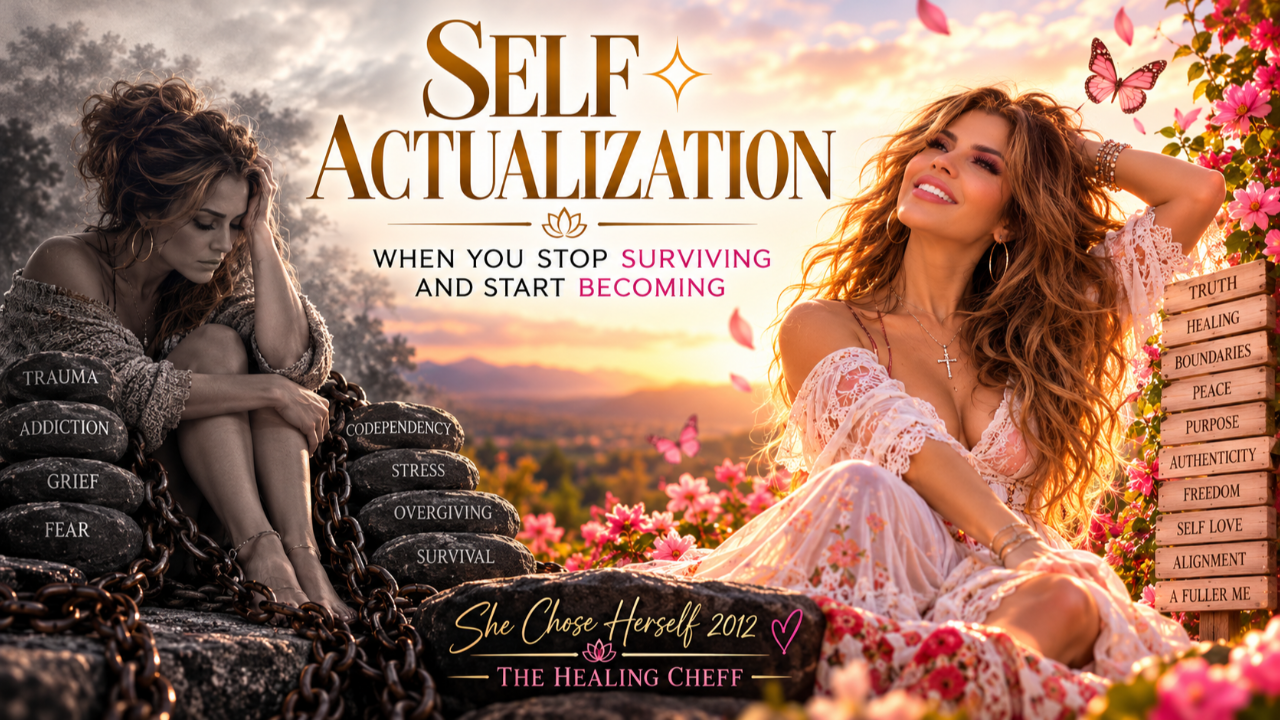
SELF ACTUALIZATION ✨
WHEN YOU STOP SURVIVING AND START BECOMING 🌸
What if the person you have spent your entire life becoming is not entirely who you are, but who you had to become to survive?
What if the strength everyone admires in you was born from circumstances that never allowed you to be vulnerable? What if your independence developed because depending on someone else never felt safe? What if your need to rescue, achieve, control, please, or care for everyone around you was never simply your personality, but a collection of survival patterns you learned long before you understood what survival really meant?
And perhaps the most uncomfortable question of all is this: If you stopped being everything everyone needed you to be, would you still know who you are?
I have been sitting with that question, and it has opened something profound within me.
For much of my life, I believed I was my roles. I was the strong one, the wife, the mother, the chef, the caretaker, the counselor, the helper, and sometimes the rescuer. I was the woman who could carry extraordinary responsibilities, solve problems, feed people, comfort hurting souls, and somehow find the strength to keep moving even when I was emotionally exhausted.
I found purpose in those roles, and I still do. There is something sacred about being of service, loving people, raising children, creating something meaningful, and using the gifts God has given us to make another person's life a little lighter.
But somewhere along the way, I began to recognize a difference between serving from love and serving from survival.
One comes from the fullness of who we are. The other can come from the fear of what might happen if we stop.
And that distinction changed the way I began looking at myself.
🌸 WHEN SURVIVAL BECOMES YOUR IDENTITY
Trauma does not always look like one devastating event. Sometimes it is years of emotional uncertainty, abandonment, grief, addiction, dysfunction, codependency, chronic stress, or living in environments where your emotional needs were not consistently safe to express.
Sometimes survival looks remarkably successful from the outside.
It can look like the woman who builds a business, raises a family, keeps everyone fed, never misses an obligation, and rarely asks anyone for help. It can look like the man who works endlessly, provides for everyone, never cries, never complains, and quietly believes his worth depends on what he accomplishes.
It can look like perfectionism, emotional withdrawal, excessive independence, controlling behavior, constant achievement, rescuing others, people pleasing, or the inability to sit peacefully with ourselves.
Some people become addicted to chaos because calm feels unfamiliar. Others seek validation through relationships, work, food, substances, or accomplishments because somewhere along the way they began believing that simply being themselves was not enough.
These patterns are not always conscious choices. Many begin as ways of protecting ourselves when we do not yet have the tools, safety, or awareness to respond differently.
And here is what I find so fascinating about the human experience.
Something that once helped us survive can eventually become the very thing preventing us from living fully.
The independence that protected you can make intimacy difficult. The perfectionism that earned you praise can steal your peace. The ability to anticipate everyone's needs can leave you disconnected from your own. The strength that carried you through tragedy can convince you that resting is weakness.
I know these patterns because I have lived many of them.
I have overgiven, carried responsibilities that were not mine, ignored my own emotional needs, and confused being needed with being loved. I have spent seasons of my life so focused on keeping everything together that I barely stopped to ask whether the life I was maintaining was nourishing the woman living it.
And eventually, even the strongest person becomes tired.
Not necessarily tired of loving others.
Tired of disappearing inside the responsibility of loving everyone else.
✨ WHAT SELF ACTUALIZATION REALLY MEANS
Psychologist Abraham Maslow introduced self actualization as part of his theory of human motivation. At its heart, the concept is about realizing our potential and becoming more fully who we are capable of being.
It is not about becoming perfect, superior, endlessly productive, or more impressive to the world.
It is about authenticity, growth, creativity, meaning, and living in greater alignment with our values.
And this is where psychology and my personal faith begin to meet.
I believe God created each of us with gifts, purpose, individuality, and the capacity to love and grow. Yet life experiences can influence how freely we express those gifts.
We may become so accustomed to protecting ourselves that we mistake protection for personality.
We may become so practiced at performing our roles that we forget we are human beings beyond those roles.
And we may spend years asking God to change our circumstances while overlooking the invitation to examine what is happening within us.
For me, self actualization is not about inventing a completely different woman.
It is about discovering who I am when fear, obligation, approval, and survival are no longer making all my decisions.
It is learning that I can be loving without rescuing, generous without abandoning myself, strong without being hardened, independent without refusing support, and purposeful without constantly proving my worth.
It is recognizing that I can be a mother, a chef, a businesswoman, a student, a woman in recovery, and a person of faith without allowing any single role to define the entirety of my existence.
I am allowed to be more than what I do for other people.
And so are you.
🌸 WHY HEALING CAN FEEL SO UNCOMFORTABLE
One of the most important things I am learning is that understanding a pattern intellectually does not mean we immediately stop feeling its emotional pull.
Our nervous systems adapt to repeated experiences. When uncertainty, conflict, excessive responsibility, or emotional unpredictability have been part of our lives for years, familiar responses can become automatic.
This is why peace may initially feel strange to someone accustomed to chaos. Why receiving help may feel uncomfortable to someone who learned to do everything alone. Why setting a boundary may trigger guilt, even when that boundary is healthy.
And why resting on the couch, doing absolutely nothing, can feel more difficult than completing an entire day's worth of responsibilities.
Think about that.
A person can survive enormous hardship, build an extraordinary life, accomplish remarkable things, and still struggle to sit quietly without feeling that they should be doing something productive.
I recognize that woman.
She is the woman who can accomplish ten things and still focus on the eleventh thing she did not finish. She is the woman who feels responsible for other people's happiness. She is the woman who sometimes confuses exhaustion with accomplishment.
But I am learning something different.
Rest is not something I must earn. Love is not something I must perform for. And my worth does not increase or decrease according to how useful I have been today.
Healing asks us to question the beliefs that have quietly governed our lives.
It asks us to recognize that guilt does not automatically mean we are doing something wrong, that discomfort does not always mean danger, and that another person's disappointment does not necessarily mean we have failed them.
Most importantly, it asks us to develop the ability to respond to life consciously instead of allowing old emotional patterns to make every decision for us.
✨ THIS IS NOT JUST A WOMAN'S JOURNEY
Men experience these struggles too, although their survival patterns may look different.
Many men grew up hearing that strength meant suppressing emotions, never appearing weak, achieving at all costs, remaining in control, and handling their struggles privately. Some learned that vulnerability invited rejection or that their value depended primarily on what they could provide.
Many women learned that love meant sacrificing themselves, tolerating discomfort, keeping everyone happy, rescuing others, or making themselves smaller to preserve a relationship.
Of course, these expectations are not universal. Men and women can develop any of these patterns.
But the consequences can be similar.
We become disconnected from our emotions, our needs, our relationships, and sometimes our spiritual lives.
Healthy masculinity does not require emotional disconnection, just as healthy femininity does not require endless self sacrifice.
Both men and women deserve relationships where honesty is safe, tenderness is welcomed, boundaries are respected, and love does not require abandoning oneself.
Healing is not about becoming less masculine or less feminine. It is about becoming more emotionally whole.
🌸 SO HOW DO WE ACTUALLY BEGIN HEALING?
Awareness is powerful, but awareness without action can leave us repeatedly identifying the same patterns without changing our lives.
I believe real transformation requires willingness, honesty, practice, and grace. We have to learn new ways of living, not simply become experts at explaining why we struggle.
Here are seven practices I am learning to embrace.
1. Learn to recognize when you are responding from survival rather than truth.
Before reacting, rescuing, overexplaining, withdrawing, or immediately saying yes, ask yourself what is motivating the response. Am I acting from love, or am I afraid of disappointing someone? Am I setting this boundary because it honors my values, or am I trying to control an outcome? Am I making this decision from peace or from fear?
The goal is not to judge yourself. The goal is to become aware enough to choose differently.
2. Stop confusing your worth with your usefulness.
You are valuable when you are productive, and you are valuable when you are resting. You are worthy when people need you, and you are worthy when nobody is asking anything of you. Practice allowing yourself moments when you are not accomplishing, fixing, proving, or providing.
Sometimes healing is sitting on the couch, doing absolutely nothing, and realizing, "I am still me. I am still worthy. And I do not have to earn this moment."
3. Learn to set boundaries without making guilt your compass.
A healthy boundary is not punishment, rejection, or an attempt to control another person. It is an honest expression of what you can participate in while remaining aligned with your values.
You can love someone and still say no. You can forgive someone and still require accountability. You can care deeply about another person's struggles without making their healing your personal responsibility.
4. Practice receiving instead of always giving.
Allow someone to help you. Accept a compliment without minimizing it. Let another person show up for you without immediately wondering how you will repay them.
Receiving is not weakness. Healthy relationships require room for both people to give, receive, and be supported.
5. Learn to tolerate peace without creating another problem to solve.
When life becomes quieter, notice the urge to fill every moment with work, worry, conflict, or another responsibility.
Try sitting in stillness. Take a walk. Pray. Breathe. Enjoy a meal without rushing. Spend time with people who do not require you to perform.
Teach yourself through repeated experience that peace does not have to be followed by disaster.
6. Build a life that reflects your values, not merely your wounds.
Ask yourself what genuinely brings you alive. What would you pursue if you were not trying to impress anyone? What relationships encourage your growth? What work feels meaningful? What parts of yourself have been waiting for permission to emerge?
Healing is not only about understanding the past. It is about intentionally creating a future that is no longer governed by it.
7. Allow God, community, and appropriate support to be part of your healing.
For me, sobriety and recovery have taught me that I do not have to walk through life alone. I can seek spiritual guidance, listen to others, remain teachable, take accountability, and accept help without surrendering my responsibility for my own growth.
Support may come through recovery communities, trusted relationships, counseling, therapy, spiritual practices, or other healthy resources.
We can be responsible for our healing without believing we must accomplish it in isolation.
✍️ QUESTIONS THAT MAY CHANGE THE WAY YOU SEE YOURSELF
I invite you to sit with these questions, not as another assignment to complete perfectly, but as an opportunity to become curious about the person beneath your responsibilities.
🌸 Who am I when nobody needs anything from me?
🌸 Which parts of my personality developed to help me feel safe?
🌸 Am I making decisions from my values or from my fear of losing approval?
🌸 Do I know the difference between loving someone and feeling responsible for them?
🌸 What do I believe would happen if I stopped proving myself?
🌸 Can I receive love without feeling obligated to earn it?
🌸 What emotions have I learned to suppress because expressing them once felt unsafe?
🌸 Am I attracted to peace, or does familiarity sometimes lead me toward chaos?
🌸 Where am I confusing being strong with never needing support?
🌸 What relationships allow me to be fully myself?
🌸 What would I do differently if I believed I was already enough?
🌸 What kind of life reflects my soul, my faith, and my purpose rather than simply my past?
And perhaps the most important question of all:
If I no longer needed survival to define me, who would I give myself permission to become?
✨ THE BEAUTIFUL TRUTH ABOUT BECOMING
I used to think healing meant reaching some extraordinary place where I would never feel fear, never make mistakes, never struggle with old patterns, and never experience emotional discomfort again.
But I am beginning to understand that healing is not the absence of struggle.
It is the growing ability to recognize what is happening within us, take responsibility for our choices, and return to ourselves with honesty and compassion.
Self actualization is not a finish line where we suddenly become enlightened and never have another difficult day.
It is a lifelong process of becoming more conscious, more authentic, more emotionally responsible, and more aligned with what matters most.
I can still be strong, but I no longer have to carry everything.
I can still serve others, but I no longer have to disappear in the process.
I can still be ambitious, but I no longer have to measure my worth by my achievements.
I can still love deeply, but I no longer have to abandon myself to keep that love.
And I can still be a woman of extraordinary purpose while allowing myself the softness, tenderness, rest, and joy of simply being alive.
That, to me, is freedom.
That is what recovery continues to teach me.
And that is the beautiful work of becoming.
Because the goal was never to become so strong that nothing could touch me. The goal is to become so grounded in who I am that I no longer have to lose myself every time life touches me.
I believe God did not create us merely to survive our lives. He gave us the capacity to grow, to love, to learn, to create, to serve, and to experience the fullness of being human.
Perhaps healing is not about returning to an untouched version of ourselves before life happened. Perhaps it is about honoring everything we have survived while discovering who we can become with the wisdom we have gained.
And perhaps one of the most beautiful spiritual awakenings is realizing that we do not have to spend the rest of our lives being governed by the very things we once needed to survive.
We can be grateful for the person who carried us through survival without requiring that person to carry us through the rest of our lives.
That is self actualization.
That is recovery.
That is becoming.
And sometimes the most courageous thing we can do is stop asking, "Who does everyone need me to be?" and finally begin asking, "God, who did You create me to become?" 🌸✨
With love, faith, and a heart that is still learning,
Michelle Ann 🌸
She Chose Herself 2012 ✨
The Healing Cheff 🌸
TheHealingCheff.com
#SelfActualization #HealingJourney #RecoveryAndGrowth #RecoverReinventRise #TheHealingCheff
Stay connected with news and updates!
Join our mailing list to receive the latest news and updates from our team.
Don't worry, your information will not be shared.
We hate SPAM. We will never sell your information, for any reason.