🍷 THE THREE DESTINATIONS OF UNTREATED ALCOHOLISM
Jun 24, 2026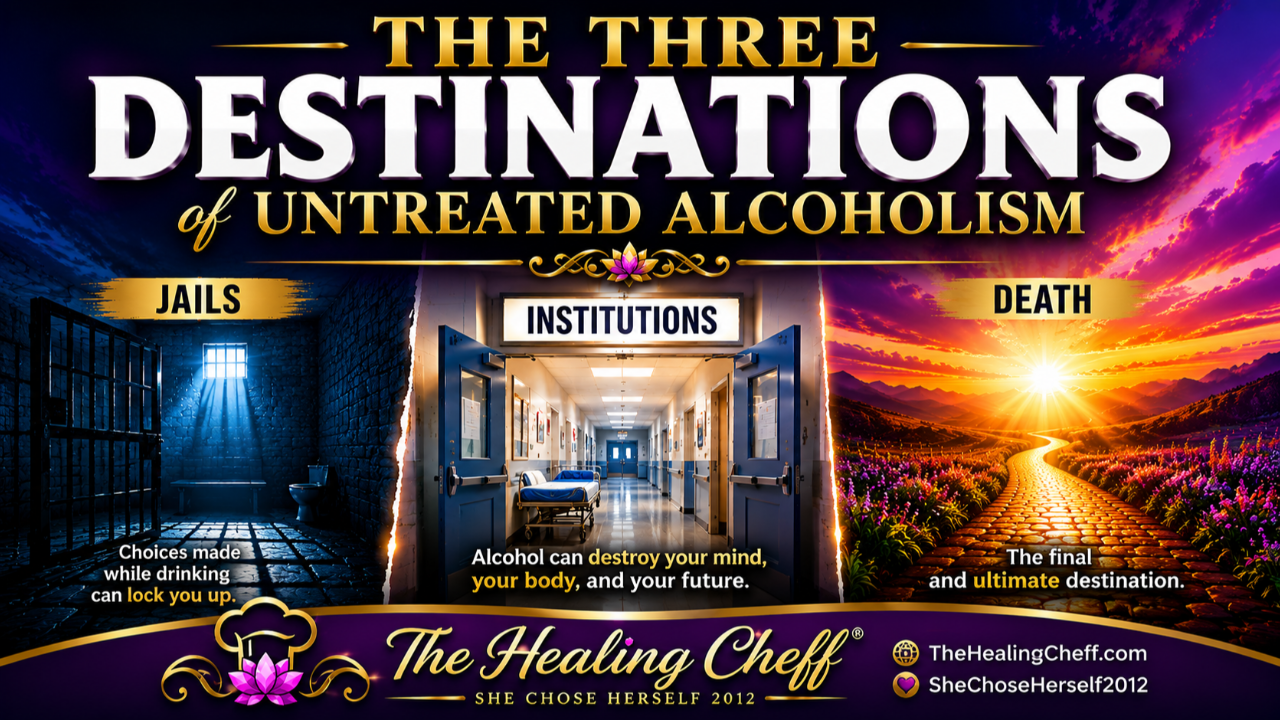
One of the most sobering truths found in the Big Book of Alcoholics Anonymous is that alcoholism is a progressive disease.
It never gets better on its own.
It always gets worse.
The Big Book tells us that if alcoholism is left untreated, the alcoholic ultimately ends up in one of three places:
⚖️ Jails
🏥 Institutions
⚰️ Death
Not everyone arrives at the same destination in the same way or at the same speed, but alcoholism is progressive. It takes more and more over time.
It steals our health.
It steals our peace.
It steals our relationships.
It steals our freedom.
And eventually, it can steal our lives.
Alcohol is not harmless.
Alcohol is a toxin.
In fact, alcohol is classified as a poison. The body treats it as a toxic substance and works hard to eliminate it. While drinking may initially create feelings of relaxation, confidence, or escape, alcohol is actually affecting the brain, nervous system, liver, heart, and nearly every organ in the body.
Over time, what begins as relief often becomes dependence. What begins as fun often becomes suffering. What begins as a solution eventually becomes the problem.
That is why alcoholism is often described as cunning, baffling, and powerful.
⚖️ JAILS
Many alcoholics find themselves in legal trouble because alcohol affects judgment, decision making, and impulse control.
What starts as "having a few drinks" can quickly turn into consequences that change lives forever.
This can include:
• DUIs
• Public intoxication
• Domestic violence
• Assaults
• Theft
• Accidents
• Probation violations
Many people who would never commit certain acts while sober find themselves doing things completely out of character when drinking.
Alcohol lowers inhibitions and impairs judgment.
People often wake up unable to explain their behavior, wondering how they became someone they no longer recognize.
The tragedy is that many alcoholics do not intend to hurt anyone. Yet the disease continues progressing, and the consequences continue growing.
🏥 MENTAL INSTITUTIONS & "WET BRAIN"
Alcohol affects every organ in the body, but one of the most devastating effects is what it does to the brain.
Long term alcohol abuse can lead to severe cognitive impairment, memory loss, confusion, and psychiatric symptoms.
One condition often referred to as "wet brain" is Wernicke Korsakoff Syndrome, a serious brain disorder caused primarily by a severe deficiency of vitamin B1, also known as thiamine. This condition is commonly seen in chronic alcoholics because alcohol interferes with the body's ability to absorb and use this essential vitamin.
Symptoms can include:
• Severe memory loss
• Confusion
• Hallucinations
• Difficulty walking
• Inability to learn new information
• Personality changes
• Making up stories to fill memory gaps
• Disorientation and inability to care for oneself
Some people never fully recover.
Many require long term care or assisted living.
Alcohol can literally damage the brain to the point that a person can no longer function independently.
• Personality Changes
One of the most heartbreaking realities of alcoholism is that the disease does not just affect a person's drinking. It affects the person themselves.
Family members often describe watching someone they love slowly disappear right in front of them. The kind, loving, dependable husband, wife, father, mother, son, daughter, or friend they once knew begins to change. At first the changes may seem subtle. A little more irritability. A little more isolation. A few more broken promises. But as alcoholism progresses, those changes often become impossible to ignore.
Alcohol affects the brain, emotions, judgment, and behavior. Over time, many alcoholics become increasingly self centered, not because they are bad people, but because the disease becomes the center of their lives. Their thoughts become consumed with drinking, recovering from drinking, hiding drinking, or planning the next drink.
People who were once honest may begin lying.
People who were once responsible may begin neglecting commitments.
People who deeply love their families may begin pulling away from them.
Many become emotionally unpredictable. One day they seem fine. The next day they are angry, defensive, withdrawn, or irrational. Family members often find themselves walking on eggshells, never knowing which version of their loved one they will encounter.
The saddest part is that loved ones often recognize the change long before the alcoholic does.
Many families eventually say:
"It is like he is still here, but he is not the same person anymore."
And that is often the grief of alcoholism. The person is physically present, but the disease has slowly begun to overshadow the qualities that once made them who they were.
• Making Up Stories to Fill Memory Gaps
One of the more frightening effects of long term alcoholism is what can happen to memory.
Many alcoholics experience blackouts, periods of time where they were awake, talking, driving, working, or interacting with others but later have absolutely no memory of what happened. As alcohol related brain damage progresses, those memory problems can become even more severe.
In some cases, the brain begins filling in missing information. This is known as confabulation.
What makes confabulation so confusing for family members is that the person is often not intentionally lying. They genuinely believe what they are saying is true.
Their brain is attempting to create a story that makes sense of missing pieces of memory.
A person may insist a conversation happened when it did not.
They may believe they completed a task they never completed.
They may remember events differently than everyone else who was present.
They may become angry, defensive, or confused when someone challenges their version of reality.
To loved ones, it can feel like constant dishonesty.
To the alcoholic, it often feels completely real.
This can create tremendous conflict within families because both people believe they are telling the truth.
Trust begins to erode.
Relationships suffer.
And everyone involved is left confused and hurt.
🏥 ALCOHOL CAN MAKE PEOPLE SEEM INSANE
The Big Book often refers to the alcoholic mind as suffering from a kind of insanity.
Not insanity in the legal sense.
But the insanity of repeatedly returning to the very thing that is destroying us.
Swearing we will never drink again, only to drink again.
Losing jobs, marriages, homes, health, and opportunities, yet continuing to pick up the next drink.
Believing that somehow this time will be different.
Thinking we can control something that has repeatedly proven it controls us.
From an AA perspective, what often stands out is that alcoholism is progressive. Many families watch someone slowly become less and less like the person they once knew.
The Big Book describes alcoholics as suffering from a mental obsession that leads them back to drinking despite consequences. As the disease progresses, loved ones may notice increased dishonesty, more excuses and rationalizations, memory lapses and blackouts, emotional volatility, isolation, neglect of responsibilities, loss of relationships, and increasing self centeredness driven by the disease.
Many family members say:
"It is like he is still here, but he is not the same person anymore."
That is often the grief of watching alcoholism take hold.
Children, spouses, parents, and friends are often left mourning someone who is still alive. Not because they stopped loving them, but because the disease has changed them.
As alcoholism progresses, people may also experience paranoia, severe anxiety, depression, hallucinations, delusions, alcohol induced psychosis, and suicidal thoughts.
Many alcoholics become emotionally, mentally, physically, and spiritually unrecognizable from who they once were.
The frightening reality is that alcohol is a poison that can affect not only the body but also a person's perception of reality.
CIRRHOSIS OF THE LIVER
The liver's job is to filter toxins from the body.
Alcohol is a toxin.
When the liver is forced to process alcohol day after day, year after year, damage begins to occur.
The progression often starts with fatty liver disease and can advance to alcoholic hepatitis, liver scarring, liver failure, and eventually cirrhosis.
Cirrhosis occurs when healthy liver tissue is replaced with scar tissue.
Once significant scarring occurs, the liver can no longer function properly.
Symptoms may include yellowing of the skin and eyes, swelling of the abdomen, internal bleeding, extreme fatigue, confusion, and organ failure.
In many cases, the damage cannot be reversed.
For some, the only hope is a liver transplant.
For others, it becomes a death sentence.
⚰️ DEATH
Alcohol kills.
Not always quickly.
Sometimes slowly.
Sometimes over decades.
But alcoholism is fatal if left untreated.
Alcohol related deaths can occur from liver disease, heart disease, cancer, alcohol poisoning, accidents, falls, suicide, and overdose.
Many alcoholics die long before their time.
Not because they are weak.
Not because they are bad people.
Not because they lack willpower.
But because alcoholism is a powerful, progressive, and deadly disease.
🌸 THE GOOD NEWS
The Big Book does not stop at jails, institutions, and death.
It offers another solution.
Recovery.
Sobriety.
Freedom.
Healing.
A spiritual awakening.
The compassionate stance is:
"I hope they get help."
The realistic stance is:
"If they continue drinking, the disease will likely continue progressing."
And the recovery stance is:
"Their recovery is their responsibility."
That does not mean we stop caring.
It means we recognize that no amount of love, worry, reasoning, rescuing, or suffering on our part can make another person become willing to recover.
Sometimes all we can do is pray, keep healthy boundaries, and remember the same truth the Big Book teaches:
Alcoholism is progressive, but recovery is possible for anyone who becomes willing to seek help.
People rebuild marriages.
People reconnect with children.
People restore their health.
People discover purpose.
People find God.
People who were once headed toward jails, institutions, or death begin living lives beyond anything they thought possible.
🌸🙏✨
The Healing Cheff®
She Chose Herself 2012
TheHealingCheff.com
Stay connected with news and updates!
Join our mailing list to receive the latest news and updates from our team.
Don't worry, your information will not be shared.
We hate SPAM. We will never sell your information, for any reason.