Sometimes Love Says Yes. Sometimes Recovery Says Wait.
Jun 12, 2026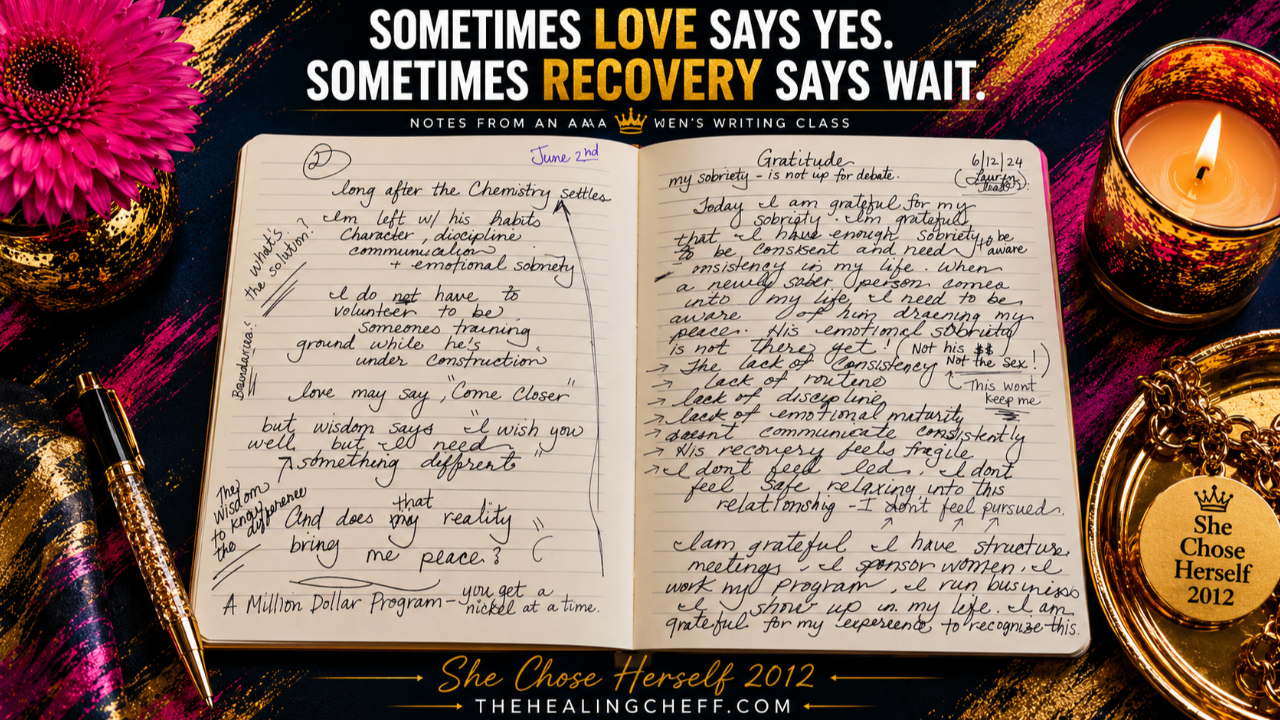
She's writing ....
Sometimes Love Says Yes. Sometimes Recovery Says Wait.
Sometimes Love Says Yes. Sometimes Recovery Says Wait.
One of the unexpected gifts of long-term recovery is awareness.
Recovery teaches us to pay attention to what brings peace into our lives and what takes peace away. It teaches us to recognize patterns, trust our intuition, honor our boundaries, and protect the serenity we worked so hard to find.
For many of us, there comes a time when we find ourselves caring deeply about someone who is newer to sobriety than we are. Sometimes we meet them in recovery. Sometimes we meet them elsewhere. Sometimes they are already sober when we meet. Sometimes they begin their sobriety journey after our paths cross.
They may be kind. They may be trying. They may genuinely want a better life. They may even possess qualities we admire. We may see their potential, their heart, and their desire to grow.
Yet something feels unsettled.
That feeling can be difficult to explain. It isn't always about money. It isn't always about physical attraction. It isn't always about chemistry. It isn't even about sex.
Those things may matter, but they are rarely enough to sustain a healthy relationship.
Long after the chemistry settles, we are left with a person's habits, character, discipline, communication, consistency, accountability, and emotional sobriety. Those are the qualities that determine whether a relationship becomes a place of peace or a source of chaos.
One of the reasons newcomers are often encouraged to avoid romantic relationships during their first year of sobriety is not because relationships are bad. It is not because sponsors are anti-love. Rather, it is because the first year of recovery is often about learning how to stand on your own two feet emotionally, spiritually, and mentally before asking another person to walk beside you.
Recovery asks us to build a relationship with ourselves, our Higher Power, and our program before we build a romantic relationship with someone else.
The suggestion exists because the first year of sobriety is often a period of enormous emotional, mental, physical, and spiritual change. Many people arrive in sobriety without knowing who they are without alcohol or drugs. Their emotions may feel overwhelming. Their coping skills are still developing. Their routines are still being built. Their identity is still being discovered.
Recovery asks people to do something they may have never done before: sit with uncomfortable feelings without escaping them. Fear, loneliness, rejection, shame, abandonment, insecurity, and uncertainty often rise to the surface when alcohol or drugs are removed.
For many newcomers, these feelings are being experienced without a substance to numb them for the first time in years.
A romantic relationship can sometimes become a distraction from that work.
A newcomer may mistake attraction for compatibility. They may mistake chemistry for connection. They may mistake being needed for being loved. They may look to another person to provide the comfort, validation, security, or sense of worth that recovery is teaching them to develop from within.
The danger is not the relationship itself. The danger is becoming emotionally dependent on another person before learning how to stand on one's own feet.
Another challenge that can arise in early sobriety is the temptation to make a relationship the center of one's recovery. This usually isn't done intentionally. In fact, it often comes from a sincere desire for connection, companionship, and support.
However, when a newcomer begins relying too heavily on a romantic partner for their emotional well-being, growth can become stalled. Instead of building their own network, they may begin borrowing someone else's. Instead of developing their own routines, they may begin fitting themselves into another person's routines. Instead of attending meetings because they are committed to their recovery, they may attend because someone else is going.
Over time, this can create an unhealthy dynamic for both people. The newcomer may become overly dependent on the relationship, while the person with more recovery may begin carrying responsibilities that were never theirs to carry.
RECOVERY WORKS BEST WHEN IT BELONGS TO THE INDIVIDUAL.
Every person needs:
• Their own meetings
• Their own sponsor
• Their own fellowship
• Their own friendships
• Their own spiritual practices
• Their own relationship with a Higher Power
A healthy relationship can support recovery, but it should never replace it.
No one person can become another person's recovery program.
The strongest relationships in recovery are often built between two people who are each standing firmly on their own foundation. They walk beside each other, support one another, and encourage one another, but neither person becomes responsible for carrying the other.
Recovery was never designed to be outsourced to a partner. It was designed to be built from the inside out.
A relationship can be a blessing.
A sponsor can be a blessing.
A fellowship can be a blessing.
But none of those things can replace the personal responsibility required to build and maintain one's own recovery.
This is why many old-timers suggest waiting. Not because they want people to be alone, but because they want people to become emotionally stable, spiritually grounded, and secure in their recovery before building a relationship that can withstand life's challenges.
The first year is often about learning how to live.
The second challenge is learning how to share that life with someone else.
When two newcomers get together, they may unintentionally become each other's higher power, therapist, sponsor, accountability partner, emotional support system, and primary source of validation all at once. That can create tremendous pressure on a relationship that is still in its infancy.
Healthy relationships require two people who can take responsibility for their own recovery, their own emotions, and their own growth. That doesn't mean relationships in early sobriety never work. Some do.
But the question isn't whether they can work.
The question is whether both people are emotionally ready for the work that a healthy relationship requires.
For those of us with more time in recovery, this can create a difficult dilemma. We understand exactly where the newcomer is because we've been there ourselves. We remember the confusion. We remember the fear. We remember trying to find our footing.
At the same time, recovery has changed us.
Over time, we have learned the value of:
• STRUCTURE
• CONSISTENCY
• DISCIPLINE
• ACCOUNTABILITY
• EMOTIONAL SOBRIETY
These are not small things.
For many of us, these principles became the foundation upon which we rebuilt our lives. They are the very things that helped us get sober, stay sober, repair relationships, build trust, strengthen our faith, and find peace.
We attend meetings, work our programs, seek spiritual growth, show up for our responsibilities, and build lives we no longer need to escape from.
When someone lacks structure, consistency, discipline, accountability, or emotional sobriety, it doesn't necessarily make them a bad person. It may simply mean they are earlier in their journey.
However, those deficiencies can still affect the people around them.
Recovery teaches us that peace is not found in chaos.
Peace is found in stability.
Peace is found in knowing someone's words and actions match.
Peace is found in consistency.
Peace is found in emotional maturity.
Peace is found in people who take responsibility for their own recovery, their own growth, and their own choices.
For those with longer-term recovery, a lack of these qualities can feel unsettling because we remember what life was like before we developed them ourselves. We worked hard to build a life rooted in recovery, and naturally we are drawn toward people whose lives reflect similar principles.
This is not judgment.
It is awareness.
My sobriety is not up for debate.
My serenity is not up for negotiation.
Perhaps most importantly, we develop enough awareness to recognize when something begins to disturb our peace.
Sometimes what we think is irritation is actually awareness.
WE MAY TELL OURSELVES THAT SOMEONE IS TOO LOUD, TOO EMOTIONAL, TOO INCONSISTENT, TOO NEEDY, OR TOO UNPREDICTABLE. BUT OFTEN WHAT WE ARE TRULY REACTING TO IS INSTABILITY.
Instability often shows up in practical ways, such as:
• Missed calls and inconsistent communication
• Broken commitments
• Emotional highs and lows
• Lack of routine or structure
• Poor follow-through
• Uncertainty about where we stand in the relationship
When someone is still learning how to regulate their emotions, it can affect the emotional climate of everyone around them. That does not make them a bad person. It simply means they may still be becoming the person they are meant to be.
The question then becomes: Am I willing to walk beside them while they figure that out?
There is no right or wrong answer. But there should be an honest answer.
Because compassion does not require self-sacrifice. Understanding someone's struggles does not obligate us to ignore our own needs. Supporting someone's recovery does not mean becoming responsible for it.
This is where boundaries become essential.
Boundaries are not punishments. They are not walls. They are not rejection.
Boundaries are clarity.
They allow us to care about someone without becoming responsible for their emotions, choices, growth, or recovery.
And sometimes boundaries sound like this:
But you do not have to volunteer to be someone’s training ground while they figure themselves out.
That statement is not unkind.
It is wisdom.
You can:
• Love someone
• Pray for them
• Encourage them
• Believe in them
• Cheer for their growth
And still recognize that they may not be the right partner for you at this stage of life.
You can care deeply about someone and still recognize that they're not your person.
Because love and compatibility are not the same thing.
One of the greatest gifts recovery gives us is the ability to stop asking, "Can I make this work?" and start asking, "Does this bring me peace?"
Recovery invites us to ask honest questions:
• Does this relationship support my emotional sobriety?
• Does it strengthen my recovery?
• Do I feel safe relaxing into it?
• Do I trust this person's actions?
• Do I feel led, supported, and secure?
• Am I experiencing peace or constant confusion?
Can two people at different stages of sobriety make it work?
Absolutely.
But only when both people take responsibility for their own recovery.
The person with more sobriety cannot become the sponsor, therapist, higher power, accountability partner, emotional regulator, and relationship coach for the newcomer. Eventually resentment grows where boundaries are absent.
The healthy middle ground is simple:
I can love you.
I can support you.
I can encourage you.
But I cannot recover for you.
Sometimes love says, "Come closer."
Sometimes wisdom says, "I wish you well, but I need something different."
The challenge is developing the wisdom to know the difference.
Recovery teaches us that peace is precious.
And protecting the life recovery has given me is not selfish.
It is wisdom.
Sometimes love says yes.
Sometimes recovery says wait.
Michelle Ann
The Healing Cheff®
Healing Hearts. Restoring Hope. Transforming Lives.
🌐 TheHealingCheff.com
🌐 NanasTamales.com
#TheHealingCheff #SheChoseHerself2012 #RecoveryMatters #SobrietyAndRecovery #EmotionalSobriety
Stay connected with news and updates!
Join our mailing list to receive the latest news and updates from our team.
Don't worry, your information will not be shared.
We hate SPAM. We will never sell your information, for any reason.